


Hair loss is a common concern affecting both men and women, often influencing confidence, appearance, and overall self-esteem. Whether you are experiencing a receding hairline, thinning crown, or advanced baldness, modern hair restoration techniques offer potential solutions for suitable candidates.
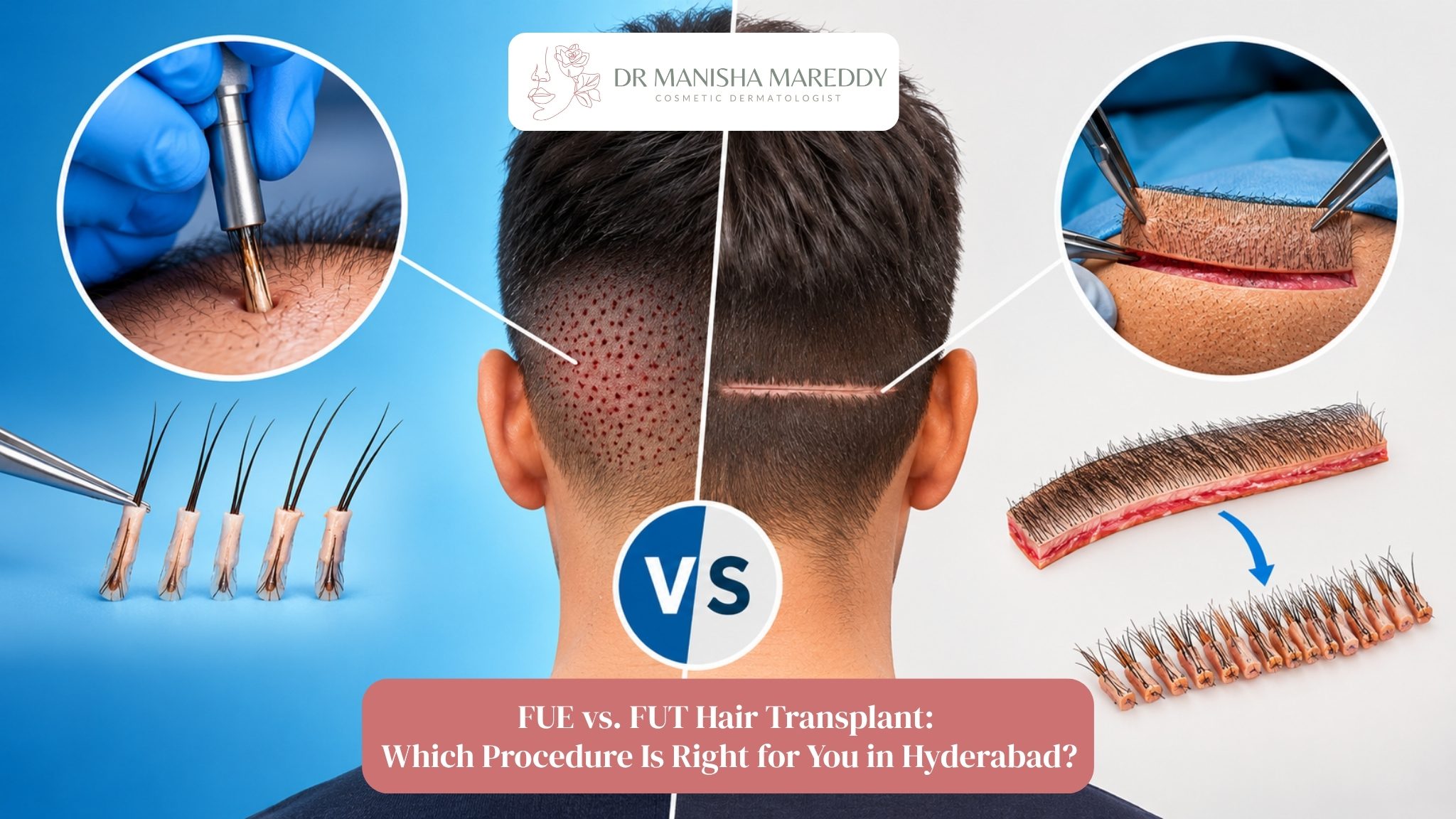
Among the most widely used surgical hair restoration techniques are Follicular Unit Extraction (FUE) and Follicular Unit Transplantation (FUT). Both procedures aim to restore hair growth by transferring healthy hair follicles from a donor area to regions affected by permanent hair loss. However, they differ in extraction methods, scarring, recovery, and suitability for individual patients.
If you are considering a hair transplant in Hyderabad, understanding the differences between FUE and FUT can help you make an informed decision.
Consulting an experienced dermatologist in Hyderabad is an important first step in identifying the cause of hair loss and understanding whether surgical or non-surgical treatment is appropriate.
In this guide, we explain FUE and FUT hair transplantation, their benefits, limitations, recovery timelines, cost considerations, and the factors that determine which procedure may be right for you.
What Is a Hair Transplant?
A hair transplant is a surgical procedure designed to restore hair coverage in areas affected by certain types of permanent hair loss.
The procedure involves extracting healthy hair follicles from a donor area, usually the back or sides of the scalp, and transplanting them into areas experiencing thinning or baldness.
Hair transplantation is commonly considered for individuals experiencing androgenetic alopecia, also known as male or female pattern hair loss.
The two major transplantation techniques are:
- FUE (Follicular Unit Extraction): Individual follicular units are extracted directly from the donor area.
- FUT (Follicular Unit Transplantation): A strip of donor scalp is removed and divided into individual follicular units.
Both techniques can provide natural-looking results when performed by qualified professionals on suitable candidates.
However, not all types of hair loss require surgical transplantation. A consultation for hair fall treatment in Hyderabad can help determine whether medical treatment, scalp therapy, or hair transplantation should be considered.
What Is FUE Hair Transplantation?
FUE hair transplant in Hyderabad is a surgical hair restoration technique in which individual follicular units are extracted from the donor area using specialised instruments.
The extracted follicles are carefully prepared and implanted into the recipient area to improve hair density and restore the appearance of a natural hairline.
Unlike FUT, FUE does not require the removal of a long strip of scalp tissue.
How Does the FUE Procedure Work?
The FUE hair transplantation procedure generally involves the following steps:
- Scalp Assessment: The surgeon evaluates the pattern of hair loss, donor hair density, and required graft coverage.
- Donor Area Preparation: The donor area is cleaned and prepared, and local anaesthesia is administered.
- Follicle Extraction: Individual follicular units are extracted using specialised instruments.
- Graft Preparation: Extracted follicles are inspected and prepared for transplantation.
- Recipient Site Creation: Small openings are created according to the planned hairline and direction of natural hair growth.
- Follicle Implantation: The extracted follicles are placed into the recipient area.
Benefits of FUE Hair Transplantation
- No long linear donor-area scar.
- Small, scattered extraction scars that may be less noticeable.
- Generally faster initial donor-area healing than FUT.
- Suitable for selected individuals who prefer shorter hairstyles.
- Allows careful extraction and distribution of individual follicular units.
- Can provide natural-looking hair restoration.
Limitations of FUE Hair Transplantation
Although FUE offers several advantages, there are certain limitations.
The procedure may require a longer extraction time, especially when a large number of grafts are needed. Extensive harvesting can also reduce donor-area density if not planned carefully.
FUE is not completely scar-free, and the number of grafts that can be safely collected depends on donor hair availability.
What Is FUT Hair Transplantation?
FUT hair transplant in Hyderabad, also known as the strip method, is a surgical technique in which a narrow strip of scalp containing healthy hair follicles is removed from the donor area.
The strip is then carefully dissected into individual follicular units, which are transplanted into the recipient area.
FUT can be useful for selected patients requiring a substantial number of grafts.
How Does the FUT Procedure Work?
The FUT hair transplantation procedure generally includes:
- Initial Evaluation: The surgeon examines the scalp, donor hair density, and extent of hair loss.
- Donor Strip Removal: A narrow strip of scalp is surgically removed from the donor region under local anaesthesia.
- Donor Area Closure: The donor wound is closed using sutures or staples.
- Graft Dissection: The removed strip is divided into individual follicular units.
- Recipient Site Preparation: Small openings are created in the areas requiring hair restoration.
- Follicle Implantation: The prepared grafts are placed into the recipient area.
Benefits of FUT Hair Transplantation
- Can provide a large number of grafts in one session.
- May be suitable for patients requiring extensive coverage.
- Allows efficient use of an appropriate donor strip.
- May reduce the need to shave a large donor area.
- Can be more economical than FUE in some clinics.
Limitations of FUT Hair Transplantation
FUT involves removing a strip of scalp, which generally leaves a linear scar in the donor region.
Patients may experience tightness, tenderness, or discomfort during healing. Recovery from the donor incision may also take longer than with FUE.
Individuals who prefer very short hairstyles may find the linear scar more noticeable.
FUE vs. FUT Hair Transplant: Key Differences
Understanding the major differences between FUE and FUT can help you choose a treatment based on your hair restoration goals, recovery preferences, and donor hair characteristics.
| Feature | FUE Hair Transplant | FUT Hair Transplant |
|---|---|---|
| Extraction method | Individual follicular units | Strip of donor scalp |
| Scarring | Small, scattered scars | Linear donor-area scar |
| Initial donor recovery | Generally quicker | May take longer |
| Stitches | Usually not required | Required for donor closure |
| Procedure time | Extraction can take longer | Often efficient for large graft sessions |
| Cost | Often higher per graft | Often lower per graft |
| Short hairstyles | May be more suitable | Linear scar may be visible |
| Large graft sessions | Possible with adequate donor supply | May offer advantages in selected cases |
| Long-term results | Can be long-lasting | Can be long-lasting |
Neither technique is universally superior. The best choice depends on individual scalp characteristics, donor hair availability, future hair loss progression, and surgical planning. American Hair Loss Association+1
Which Is Better: FUE or FUT Hair Transplant?
The decision between FUE and FUT should be based on individual medical requirements rather than popularity alone.
When FUE May Be a Better Option
FUE may be suitable for individuals who:
- Prefer shorter hairstyles.
- Want to avoid a long linear scar.
- Have suitable donor hair density.
- Require targeted hairline restoration.
- Prefer a procedure without donor-strip sutures.
- Have scalp characteristics that make strip harvesting less suitable.
When FUT May Be a Better Option
FUT may be considered for individuals who:
- Require a substantial number of grafts.
- Have suitable scalp flexibility and donor hair density.
- Prefer to retain longer hair that can conceal a linear scar.
- Need careful planning of donor hair resources for future procedures.
- Are comfortable with the donor incision and its recovery requirements.
An experienced hair transplant surgeon can assess these factors and recommend the most appropriate procedure.
FUE vs. FUT Hair Transplant Cost in Hyderabad
The hair transplant cost in Hyderabad varies depending on the number of grafts required, surgical technique, surgeon’s experience, and clinic facilities.
FUE may cost more per graft because individual follicular units are extracted separately. FUT may be more economical in some cases, particularly when a large number of grafts are required.
However, the overall cost also depends on the complexity of treatment and the clinic’s pricing structure.
Factors Affecting Hair Transplant Cost
1. Number of Grafts: Larger bald areas generally require more grafts, increasing the overall treatment expense.
2. Transplantation Technique: FUE and FUT involve different extraction methods, instruments, and surgical requirements.
3. Surgeon’s Expertise: The qualifications, experience, and involvement of the surgical team can influence pricing.
4. Donor Hair Availability: Limited donor density may require additional planning or affect the number of grafts that can be safely transplanted.
5. Clinic Infrastructure: Medical equipment, surgical facilities, and infection-control standards contribute to treatment costs.
6. Post-Procedure Care: Medications, follow-up appointments, and additional recommended treatments may affect the final expense.
Before choosing a procedure, request a detailed quotation that includes the graft count, surgeon’s fees, medications, and follow-up care.
FUE vs. FUT Recovery Time: What Should You Expect?
Recovery is an important consideration when choosing a hair transplantation technique.
First Week After Surgery
Mild redness, swelling, tenderness, and scabbing may occur after either procedure.
FUE patients may experience small extraction-site wounds, while FUT patients require additional care around the donor incision.
Second Week After Surgery
Most superficial scabs generally begin to resolve. Patients who undergo FUT may need suture or staple removal according to their surgeon’s instructions.
Two to Eight Weeks After Surgery
Transplanted hair shafts may begin shedding. This is a common part of the post-transplant hair growth cycle and does not necessarily indicate graft failure.
Three to Four Months After Surgery
New hair growth may gradually become noticeable. The emerging hair may initially appear fine or uneven.
Six to Nine Months After Surgery
Hair density and coverage may improve as more transplanted follicles enter the growth phase.
Twelve Months and Beyond
Many patients experience substantial improvement within 6–12 months, although final maturation can take longer, particularly in the crown area. American Academy of Dermatology
Are FUE and FUT Hair Transplants Permanent?
Both FUE and FUT can provide long-lasting hair restoration when healthy follicles are transplanted from suitable donor areas.
However, transplantation does not stop the progression of hereditary hair loss in untreated follicles.
Patients may continue experiencing thinning in surrounding areas even after successful surgery.
A dermatologist may recommend medical hair loss treatment to help preserve existing hair and maintain overall density.
For individuals experiencing ongoing thinning, hair loss treatment in Hyderabad may be an important part of long-term hair management.
Can Hair Loss Be Treated Without FUE or FUT?
Yes. Not every person experiencing hair loss requires surgical transplantation.
The appropriate treatment depends on the underlying cause, severity, duration, and condition of the hair follicles.
1. PRP Hair Treatment
Platelet-Rich Plasma (PRP) treatment involves collecting a small amount of the patient’s blood, processing it to concentrate platelets, and injecting the prepared plasma into selected scalp areas.
PRP may help improve hair density in some individuals with certain types of hair thinning. Results vary, and repeat sessions may be required.
Learn more about PRP hair treatment in Hyderabad.
2. GFC Hair Treatment
Growth Factor Concentrate (GFC) treatment uses a blood-derived preparation containing growth factors that are administered to selected scalp areas.
It may be considered for certain hair thinning concerns, although evidence regarding its comparative effectiveness remains limited.
Explore PRP vs. GFC hair treatment in Hyderabad to understand the differences between these procedures.
3. Medical Hair Regrowth Treatment
Certain medications may help slow hereditary hair loss or support regrowth, depending on the diagnosis.
A dermatologist may recommend appropriate treatments after evaluating your scalp, medical history, and hair loss pattern.
4. Scalp Treatment
Dandruff, inflammatory scalp conditions, and certain infections can contribute to hair-related concerns.
Treating the underlying scalp condition may be necessary before considering additional hair restoration procedures.
For personalised guidance, consult a hair specialist in Hyderabad to identify the cause of your hair loss.
Why Is a Dermatologist Consultation Important Before Hair Transplantation?
A hair transplant is not suitable for every type of hair loss.
Some individuals may experience temporary shedding caused by nutritional deficiencies, stress, hormonal changes, illness, or medication-related factors.
Others may have inflammatory or autoimmune scalp conditions requiring specific medical treatment.
Before recommending transplantation, a specialist may assess:
- Pattern and severity of hair loss.
- Donor hair density and quality.
- Scalp health and existing medical conditions.
- Age and likely future hair loss progression.
- Family history of pattern baldness.
- Previous hair restoration treatments.
- Expectations regarding hairline and density.
An accurate diagnosis helps avoid unnecessary surgical procedures and supports appropriate treatment planning.
Why Consult Dr. Manisha Mareddy for Hair Loss Concerns in Hyderabad?
If you are experiencing hair thinning, excessive shedding, or a receding hairline, a dermatological consultation can help identify the underlying cause and explore suitable treatment options.
Dr. Manisha Mareddy provides dermatology and hair-related consultations in Hyderabad, with information on hair loss management and non-surgical hair growth treatments available through her website.
Hair-related concerns and treatment options discussed on the website include hair fall, PRP, and GFC.
Patients considering FUE or FUT should confirm whether surgical transplantation is available and who would perform the procedure. The clinic’s published hair treatment information should not be taken as confirmation that both surgical techniques are offered.
Clinic: Shlok Dermatology & Wellness
Location: Kokapet, Hyderabad
Website: drmanishamareddydermatologist.com
Consultation: Visit the official website for appointment information.
Frequently Asked Questions About FUE vs. FUT Hair Transplant
1. Which is better, FUE or FUT hair transplant?
Neither procedure is universally better. FUE may be preferable for patients concerned about linear scarring, while FUT may offer advantages for selected patients requiring substantial graft harvesting. The decision depends on donor hair characteristics and individual requirements.
2. Is FUE hair transplant more expensive than FUT?
FUE is often more expensive per graft because individual follicles are extracted separately. However, actual treatment costs vary depending on graft requirements, surgeon expertise, and clinic pricing.
3. Does FUE hair transplant leave scars?
Yes. FUE leaves multiple small extraction scars in the donor area. These may be less noticeable than a FUT linear scar, but FUE is not a scar-free procedure.
4. Does FUT hair transplant provide more grafts than FUE?
FUT can provide a substantial number of grafts in selected patients. However, neither technique guarantees a higher graft count. Donor density, scalp characteristics, and surgical planning determine how many grafts can be safely harvested.
5. Which hair transplant has a faster recovery?
FUE generally involves quicker initial donor-area recovery because it avoids a long surgical incision. However, healing varies depending on the number of grafts, surgical technique, and individual health.
6. Is FUE less painful than FUT?
Both procedures are generally performed under local anaesthesia. FUT may cause more donor-area tightness during recovery, while FUE involves multiple small extraction wounds. Individual discomfort varies.
7. Can women undergo FUE or FUT hair transplantation?
Yes. Women with selected types of permanent hair loss may be candidates for either procedure. A detailed scalp evaluation is necessary to determine suitability.
8. How long do FUE and FUT hair transplant results last?
Transplanted follicles from suitable donor regions can continue growing for many years. However, surrounding natural hair may continue thinning, and medical management may be recommended.
9. Can PRP replace FUE or FUT hair transplantation?
PRP may help selected patients with hair thinning but cannot reliably replace follicles in areas of established baldness. It is not a direct substitute for surgical transplantation.
10. How do I choose the right hair restoration treatment in Hyderabad?
Consult a qualified dermatologist or hair transplant surgeon for a detailed assessment. The most appropriate treatment depends on the cause of hair loss, donor hair availability, scalp health, and individual expectations.
Conclusion
Choosing between FUE vs. FUT hair transplant in Hyderabad requires understanding the differences in extraction techniques, scarring, recovery, cost, and long-term donor hair management.
FUE may be suitable for individuals who want to avoid a linear scar and prefer shorter hairstyles. FUT may be appropriate for selected patients requiring substantial graft harvesting and careful donor-area planning.
Both techniques can provide natural-looking results when performed by qualified professionals on suitable candidates. However, not all hair loss conditions require surgery.
Non-surgical options such as PRP, GFC, and medical hair loss treatment may be appropriate depending on the underlying condition.
If you are experiencing hair thinning, baldness, or excessive hair fall, consult Dr. Manisha Mareddy in Hyderabad for a dermatological evaluation and guidance on suitable hair loss management options.