
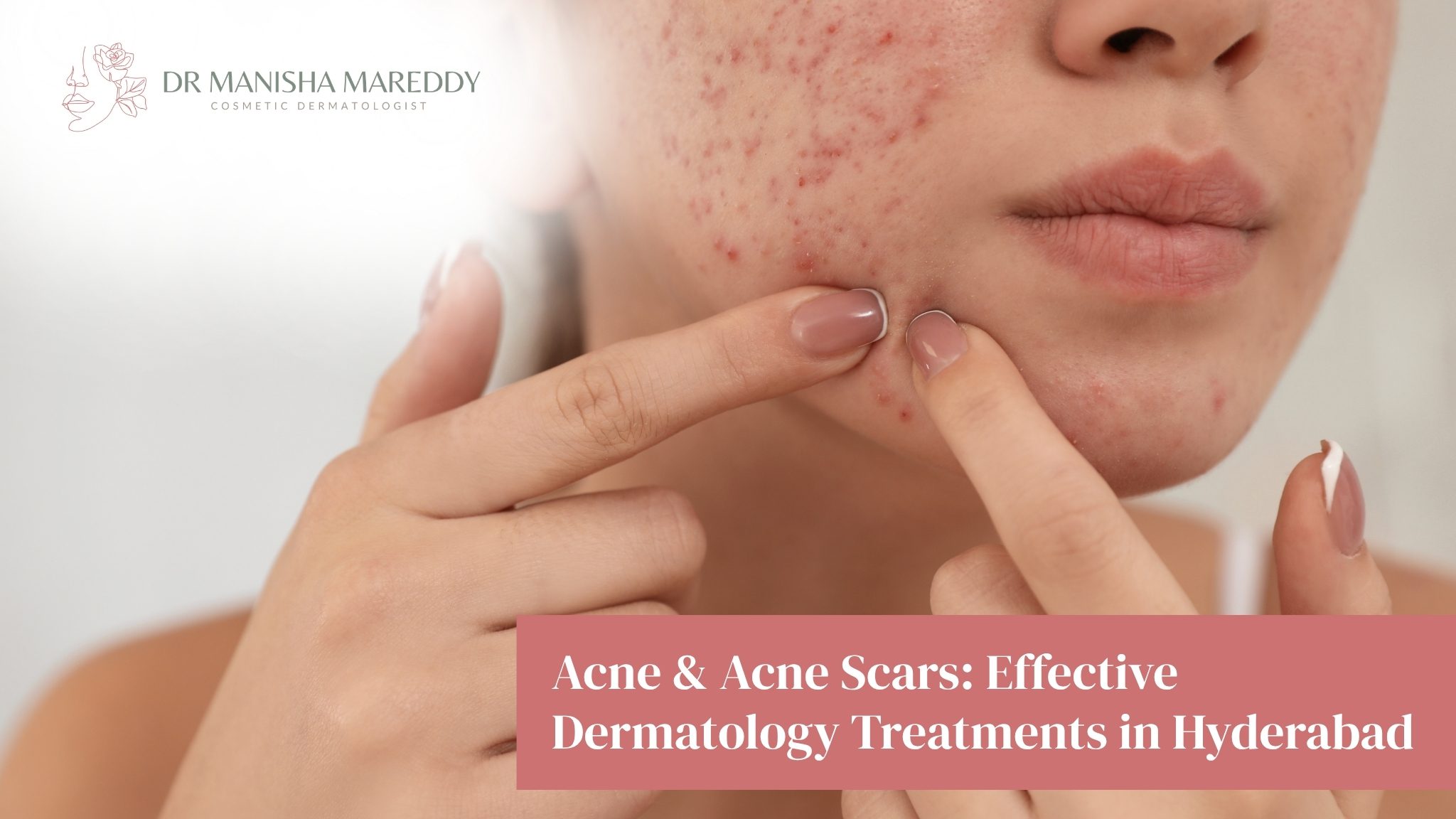
Acne and acne scars are common skin concerns that can affect teenagers and adults alike. From blackheads and whiteheads to inflamed pimples and deep, persistent scars, these conditions can influence skin texture, appearance, and confidence. Although acne is common, the right treatment depends on its severity, the type of lesions, skin sensitivity, and the presence of scarring.
If you are looking for acne treatment in Hyderabad or acne scar treatment in Hyderabad, consulting a qualified dermatologist can help identify the cause of your breakouts and determine which treatments are suitable for your skin. Dr. Manisha Mareddy at Shlok Dermatology & Wellness in Kokapet offers services for acne, acne scars, and related skin concerns, with treatment options selected according to individual needs.
This guide explores the causes of acne, the difference between acne marks and scars, available dermatological treatments, and practical steps to support healthier skin.
Understanding Acne: Why Do Pimples Develop?
Acne develops when hair follicles become blocked with oil (sebum) and dead skin cells. Inflammation and the activity of acne-associated bacteria can contribute to the development of pimples.
Several factors may influence acne, including:
- Hormonal changes during adolescence or adulthood.
- Excess oil production and clogged pores.
- Genetic predisposition.
- Certain medicines or skincare and cosmetic products.
- Stress, which may aggravate acne in some people.
- Conditions such as hormonal disorders that may contribute to persistent breakouts.
Acne can affect the face, neck, chest, shoulders, and back. It may appear as blackheads, whiteheads, red bumps, pus-filled pimples, or deeper painful nodules and cysts.
Choosing an appropriate pimple treatment in Hyderabad starts with identifying the type and severity of acne rather than relying on random skincare products or home remedies.
What Is the Difference Between Acne Marks and Acne Scars?
Acne marks and acne scars are not the same, and distinguishing between them helps guide treatment.
Acne Marks
Acne marks are areas of discolouration that remain after a pimple heals. They may appear brown, dark, pink, or red, depending on the skin tone and the type of inflammation. Some marks gradually fade, although the process may take months.
Dermatologists may recommend sun protection, suitable topical treatments, or selected procedures to manage persistent discolouration.
Acne Scars
Acne scars involve changes in skin texture or structure. They can develop when inflammation damages the skin during the healing process.
Common types include:
- Atrophic scars: Depressed areas that sit below the surrounding skin.
- Ice-pick scars: Narrow, deep scars.
- Boxcar scars: Wider depressions with more defined edges.
- Rolling scars: Shallow, sloping depressions that create uneven texture.
- Hypertrophic scars: Raised scars caused by excess scar tissue.
If you have persistent textural changes, acne scar treatment in Hyderabad may involve procedures selected according to the type, depth, and distribution of the scars.
Effective Dermatology Treatments for Acne in Hyderabad
There is no single acne treatment that works for everyone. A dermatologist may recommend medication, skincare adjustments, in-clinic procedures, or a combination of approaches.
1. Topical Medications
Topical treatments are often used for mild to moderate acne. Depending on the diagnosis, a dermatologist may recommend ingredients such as benzoyl peroxide, topical retinoids, or azelaic acid.
These treatments can help reduce clogged pores, inflammation, or acne-associated bacteria. Some may cause dryness, irritation, or increased sensitivity, so the product, strength, and frequency should be appropriate for your skin.
Prescription retinoids and other acne medications should be used according to medical advice. People who are pregnant or planning pregnancy should discuss medication safety with their doctor.
2. Oral Medications
Moderate to severe acne, widespread inflammation, or acne that does not respond adequately to topical treatment may require oral medication.
Depending on the individual, a dermatologist may consider oral antibiotics for a limited period, hormonal treatment in suitable patients, or isotretinoin for selected cases of severe or persistent acne. These medicines have different precautions and monitoring requirements.
Do not self-prescribe antibiotics or isotretinoin. A dermatologist should assess the potential benefits, risks, contraindications, and follow-up needs before recommending them.
3. Chemical Peels for Acne-Prone Skin
Selected chemical peels use controlled exfoliation to help address clogged pores, some forms of acne, and post-acne discolouration. The formulation and strength should be chosen according to the skin concern and sensitivity.
A peel may not be appropriate for every person, particularly when the skin is irritated or certain medicines are being used. Incorrectly performed peels can cause burns, irritation, or worsening pigmentation.
For suitable patients, a dermatologist may incorporate a peel into a broader pimple treatment plan.
4. Comedone Extraction
Comedones are blackheads and whiteheads that form when pores become clogged. Professional extraction may be considered for selected lesions when clinically appropriate.
Extraction should be performed with suitable instruments and hygiene practices. Squeezing pimples or attempting deep extractions at home can worsen inflammation, increase the risk of infection, and contribute to scarring.
5. Treatments for Inflamed or Cystic Acne
Deep, painful nodules and cysts may require more intensive medical treatment. In selected cases, a dermatologist may use an intralesional injection to reduce inflammation in an individual lesion.
Early assessment is particularly important for severe acne because ongoing inflammation can increase the risk of permanent scarring.
6. A Personalized Skincare Routine
A simple, consistent routine can complement medical treatment. It generally includes a gentle cleanser, a non-comedogenic moisturiser, and broad-spectrum sunscreen.
Avoid introducing multiple strong active ingredients at the same time. Over-exfoliation and harsh products can irritate the skin and make acne management more difficult.
Dr. Manisha Mareddy’s official website describes individualized acne care that may combine topical or oral medicines, skincare recommendations, and selected procedures depending on the patient’s condition.
Advanced Acne Scar Treatments Available in Hyderabad
Once active acne is under control, dermatological procedures may help improve uneven skin texture and the appearance of established scars. The most suitable approach depends on the scar type, skin tone, medical history, and tendency to develop pigmentation or raised scars.
1. Microneedling and Radiofrequency Microneedling
Microneedling creates controlled micro-injuries in the skin to stimulate its natural repair response. Radiofrequency microneedling combines microneedles with energy delivered into targeted skin layers.
These procedures may help improve selected types of depressed acne scars and uneven skin texture. Several sessions may be needed, and results develop gradually. Potential risks include redness, swelling, infection, and changes in pigmentation.
Explore Morpheus8 treatment in Hyderabad to learn about the clinic’s radiofrequency microneedling service and discuss whether it is suitable for your skin.
2. Laser Resurfacing
Certain laser procedures can improve skin texture by targeting selected layers of the skin and stimulating remodelling. The type of laser and treatment intensity should be chosen carefully, particularly for skin that is prone to post-inflammatory pigmentation.
Laser resurfacing may be useful for selected acne scars, but it is not suitable for every scar type or every patient. Ask your dermatologist about the expected improvement, downtime, number of sessions, and possible complications.
3. Subcision for Selected Depressed Scars
Some depressed acne scars are tethered to deeper tissue by fibrous bands. Subcision is a procedure in which a trained clinician releases these bands beneath the skin.
It may be considered for certain rolling scars, sometimes alongside other treatments. Bruising, swelling, infection, and other complications are possible, so the procedure requires careful assessment and appropriate aftercare.
4. TCA CROSS for Selected Deep Scars
TCA CROSS uses a concentrated trichloroacetic acid application to target specific types of narrow, deep acne scars. It is different from a conventional full-face chemical peel.
This procedure requires careful technique and patient selection because irritation and pigmentation changes can occur. It is generally considered for particular scar patterns rather than all types of acne scarring.
5. Punch Techniques for Certain Deep Scars
For selected deep or sharply defined scars, a dermatologist may consider punch excision or related surgical techniques. These approaches physically modify an individual scar and may be combined with other treatments to improve the overall appearance of the skin.
The choice depends on scar depth, size, location, and the likelihood of creating a more acceptable scar.
Dr. Manisha Mareddy’s official acne treatment page discusses options such as laser resurfacing, microneedling radiofrequency, punch excision, subcision, and TCA CROSS for selected acne scars.
How to Choose the Right Acne Scar Treatment
Different scars respond to different procedures. A consultation should establish the type of scarring and whether active acne needs treatment first.
| Skin concern | Possible treatment approach |
|---|---|
| Blackheads and whiteheads | Suitable topical medication and skincare |
| Inflamed pimples | Topical or oral medication, depending on severity |
| Dark marks after acne | Sun protection, topical treatments, selected peels |
| Shallow or rolling scars | Microneedling, radiofrequency microneedling, or subcision in suitable cases |
| Deep, narrow scars | TCA CROSS or other selected scar procedures |
| Mixed scar types | A dermatologist-designed combination approach |
Not every procedure is suitable for every skin type. A combination of treatments may be recommended, but the sequence matters. Controlling active acne first can help reduce the formation of new scars while existing scars are addressed.
Daily Skincare Tips to Help Prevent Acne and Scarring
Professional treatment works best when supported by a routine that does not irritate the skin.
- Cleanse gently: Wash your face with a mild cleanser suited to your skin.
- Moisturise regularly: Choose a non-comedogenic moisturiser to help maintain the skin barrier.
- Use sunscreen: Broad-spectrum SPF 30 or higher can help reduce sun-related worsening of post-acne dark marks.
- Avoid picking pimples: Picking, squeezing, or scratching lesions can increase inflammation and scarring.
- Introduce active ingredients gradually: Avoid using several exfoliating or irritating products at once.
- Be consistent: Many acne treatments take several weeks to show improvement.
- Seek professional advice early: Painful nodules, widespread acne, and developing scars warrant timely assessment.
Avoid harsh scrubs, unverified home remedies, and strong chemical peels used without professional guidance. If a product causes significant burning, swelling, or irritation, stop using it and seek appropriate advice.
Why Consult Dr. Manisha Mareddy for Acne and Acne Scar Treatment?
Dr. Manisha Mareddy is a dermatologist, dermatosurgeon, and trichologist at Shlok Dermatology & Wellness in Kokapet, Hyderabad. Her official profile lists MBBS, MD DVL, and fellowship training in injectables and dermatologic laser surgery.
Her clinic offers services for acne, acne scars, and other skin concerns. If you are considering acne treatment in Hyderabad or Morpheus8 treatment in Hyderabad, a consultation can help determine whether these or other approaches fit your skin condition.
A good treatment plan should explain the diagnosis, available options, likely benefits, limitations, costs, aftercare, and potential side effects. No procedure can guarantee completely scar-free skin, but appropriately selected treatment may improve the appearance of many acne scars.
Frequently Asked Questions
1. What is the best treatment for acne in Hyderabad?
The best treatment depends on acne severity, skin type, medical history, and whether scarring is present. Options may include topical medication, oral medication, selected chemical peels, and other dermatologist-directed treatments.
2. Can acne scars be removed completely?
Complete removal cannot be guaranteed. Many scars can improve with appropriate treatment, but the degree of improvement varies. Some scars require a combination of procedures, and several sessions may be needed.
3. When should I consult a dermatologist for pimples?
Consider consulting a dermatologist if acne persists, becomes painful, spreads, leaves dark marks or scars, or does not improve with suitable over-the-counter care. Early treatment can help reduce the risk of permanent scarring.
4. Is Morpheus8 effective for acne scars?
Radiofrequency microneedling may improve selected acne scars and uneven skin texture. Results depend on scar type, treatment settings, skin characteristics, and individual healing. A dermatologist should assess suitability and explain potential risks before treatment.
5. How long does acne scar treatment take to show results?
The timeline varies according to the procedure and severity of scarring. Some changes may appear over several weeks, while collagen remodelling and improvement from a series of treatments can take longer. Your dermatologist can suggest a realistic timeline after examining your skin.
6. Can I treat acne scars while I still have pimples?
In many cases, active acne should be controlled before starting procedures for established scars. Some treatments may be used alongside acne management, but the correct timing depends on the condition and the procedure being considered.
7. Where can I get acne and acne scar treatment in Kokapet, Hyderabad?
Dr. Manisha Mareddy offers acne and acne scar services at Shlok Dermatology & Wellness, 3rd Floor, MN Capital, Power Welfare Society, Kokapet, Hyderabad 500075. You can check appointment details through the official contact page or call +91 89779 25537. Confirm current appointment availability directly with the clinic.
Conclusion
Acne and acne scars need different treatment approaches. While active acne is generally managed with appropriate medication and skincare, established scars may benefit from selected procedures such as microneedling, radiofrequency microneedling, laser resurfacing, subcision, or TCA CROSS.
If you are searching for acne treatment in Hyderabad or acne scar treatment in Hyderabad, start with a professional assessment rather than choosing a procedure based only on popularity. Dr. Manisha Mareddy’s clinic offers acne and scar-related services in Kokapet, where you can discuss your concerns and explore treatment options suited to your skin.
Visit the official website of Dr. Manisha Mareddy to learn more or contact the clinic to enquire about an appointment.